PrajnaEdge
An interactive engineering platform where complex concepts become experiences—through visual explorations, simulations, and practical understanding.
PrajnaEdge Navigation Tree
Embedded Systems Tree
On the Horizon
PravahaPath
Something new is taking shape.

Articles & Write-ups

Exploring how systems evolve from hardware to integration.

Sort:

Edge AI Demonstrations

Deploying neural networks and intelligent decision loops on raw silicon targets.

Sort:
Interaction

The Physical Edge of Software

How discrete logic becomes physical consequence through GPIO.

Embedded SystemsHardwareGPIOSystems Thinking

1. The Solitary Nature of Computation

Computation is, by default, an internal process. A processor can cycle through billions of instructions per second, moving data between registers and performing complex arithmetic, yet remain completely disconnected from the world surrounding it.

In this state, software is a closed loop of logic. It exists as varying electrical charges trapped within a silicon substrate, invisible and without external consequence.

A system that only computes is a mind without a body. It possesses logic, but lacks agency.

2. GPIO: The Architecture of Intent

General Purpose Input/Output (GPIO) represents the first true boundary between the abstract world of software and the physical world of matter. It is the architectural point where a software decision manifests as an electrical reality.

Before sophisticated communication protocols existed, the industry needed a way to let a processor interact with voltage directly. GPIO was the solution—a simple, programmable gate that allowed software to control the state of a physical pin.
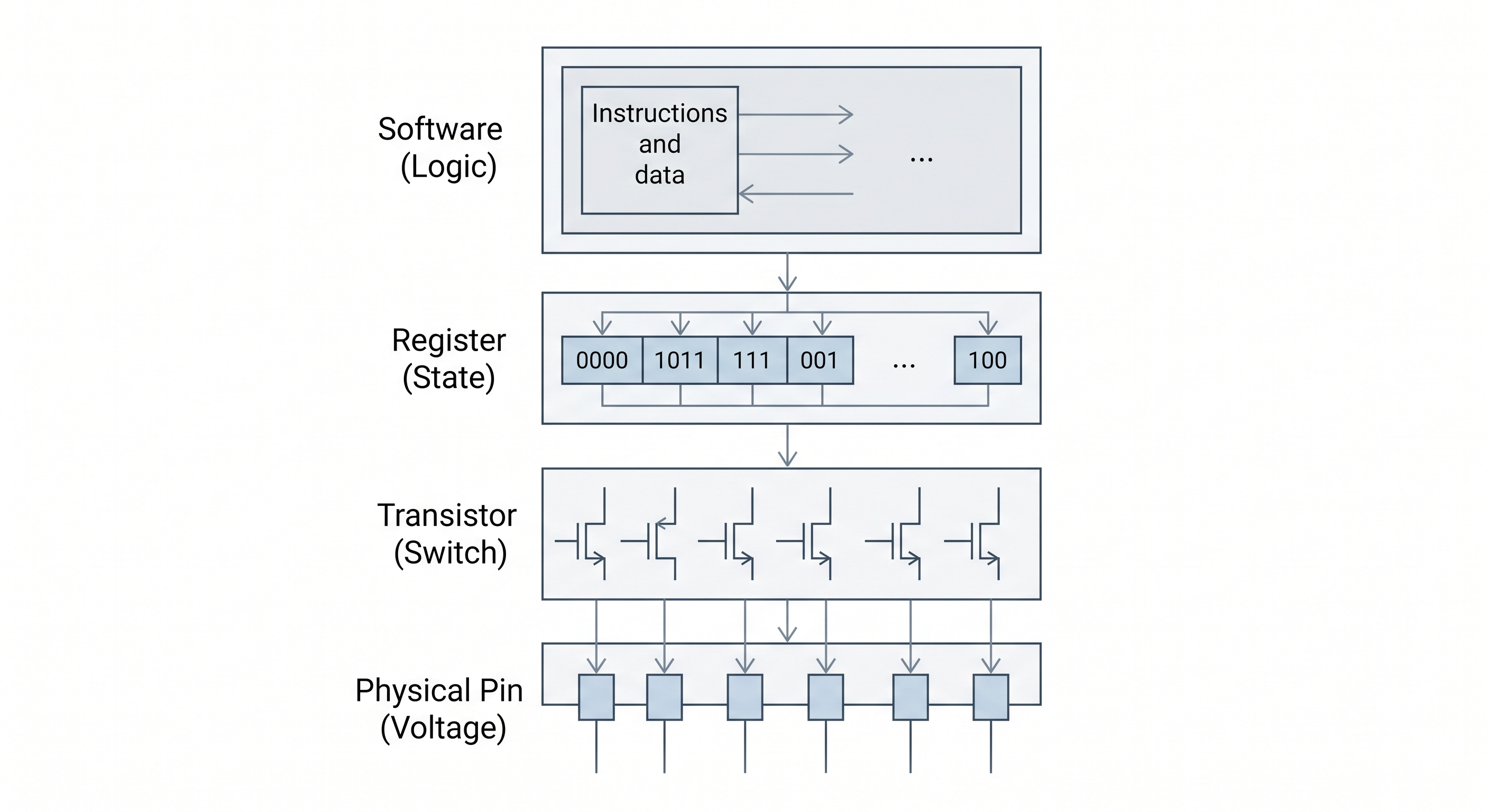
The path from software instruction to physical voltage change

GPIO acts as the bridge where software states are translated into physical potential.

3. From Memory to Matter

To a high-level developer, interacting with hardware often looks like a simple memory operation. A single line of code is written to a specific address, and the task is considered complete.

GPIOA->ODR |= (1 << 5);

While this appears to be software manipulating a variable, it is actually a physical event. That instruction triggers a cascade: the processor's bus logic selects a peripheral, a register holds a bit, and that bit controls a transistor gate. That transistor then allows current to flow, changing the voltage on a physical copper lead.

At this moment, software is no longer just information. It is energy.

4. The Scaling of Interaction

GPIO provides the foundation for agency, but it is inherently limited. To control a motor, we toggle it. To read a sensor, we measure it. But as systems grow in complexity, managing every physical interaction with individual pins becomes unsustainable.

When we need to send a temperature reading, a single pin can only say 'high' or 'low.' To convey a number, we must either use many pins or begin toggling a single pin in a specific pattern over time.

Complexity in systems engineering is often solved by moving from raw signals to structured protocols.

This fundamental limitation of GPIO is what necessitated the evolution of UART, SPI, and I2C. We moved from simply controlling voltage to using voltage as a language.

Closing Thought

GPIO is often dismissed as the simplest part of embedded engineering, yet it remains the most profound. It is the moment where the wall between a logical instruction and a physical movement finally breaks down.

Every complex system, no matter how advanced its intelligence, eventually relies on this single, humble transition: a bit becoming a voltage.

Engineering is the art of making the invisible visible through controlled interaction.
System Tree Node Interaction
ABOUT PRAJNAEDGE

Engineering concepts you don't just read — you experience.

PrajnaEdge is an interactive engineering platform where complex concepts become experiences—through visual explorations, simulations, and practical understanding.

WHY PRAJNAEDGE EXISTS

Engineering is often taught as a collection of isolated concepts.

A processor here.
A protocol there.
An operating system somewhere else.

But real systems are built by connecting these layers.

PrajnaEdge exists to make those connections visible.

Each exploration starts with a question, builds an intuition, and gradually reveals the system underneath through visualizations, simulations, practical scenarios, and connections between concepts.

HOW PRAJNAEDGE WORKS

PrajnaEdge is designed around exploration rather than passive reading.

Concepts are introduced progressively, visualized when they benefit from seeing them, and brought to life through interactive EdgeCases and simulations where appropriate.

The goal is not simply to explain what a system does, but to help the learner understand why it works the way it does.

CREATOR PROFILE

Devaharsha Meesarapu

Embedded Systems • Firmware • Edge AI

I am the engineer behind the design, development, and content of PrajnaEdge. I build low-level systems where code directly controls hardware, bridging the gap between register-level silicon behavior and intelligent edge decision loops.

View Resume →

ABOUT ME

I am an Embedded Firmware Engineer focused on developing software for resource-constrained systems. My experience spans bare-metal firmware, device drivers, microcontroller peripherals, and communication protocols, working across the boundary between hardware and software.

My work has involved microcontroller-based systems, real-time behaviour, hardware interfaces, and communication technologies such as CAN, CAN FD, UART, SPI, and I²C. I am particularly interested in understanding systems from the lowest level upward—from registers and peripherals to intelligent edge systems.

ENGINEERING PHILOSOPHY

Engineering is not just about writing code; it is about managing constraints, timings, and physical hardware characteristics. True mastery of complex systems comes from understanding the interactions across different layers of the stack.

This conviction is why I built PrajnaEdge—to bridge the gap between conceptual theory and direct, register-level physical reality.

CONNECT

LinkedIn → GitHub →

Interactive Career Journey

Let's Connect
Interested in embedded systems, AI, or building something meaningful? I'd love to hear from you.
Open to collaborations, research, and interesting engineering conversations.
Help Improve PrajnaEdge
Found something to improve? I'd love to hear your thoughts.

Bare Metal

Software that runs directly on hardware without an operating system.

Applications
Operating Systems
YOU ARE HERE
Bare Metal
Processor
Hardware

"Every embedded application begins long before main()."

Operating Systems

An Operating System manages hardware and software resources so complex applications can work efficiently.

Applications
YOU ARE HERE
Operating Systems
Bare Metal
Processor
Hardware

"When one loop is no longer enough to carry the burden."

Support PrajnaEdge

PrajnaEdge is an independent education platform built to make knowledge freely accessible.

If you find PrajnaEdge useful, you can support its continued development.

Your support helps fund the time, tools, infrastructure, and experimentation that go into building and maintaining PrajnaEdge.

Select Region
Select Amount
Select an amount to support PrajnaEdge.