Exploring how systems evolve from hardware to integration.
Deploying neural networks and intelligent decision loops on raw silicon targets.
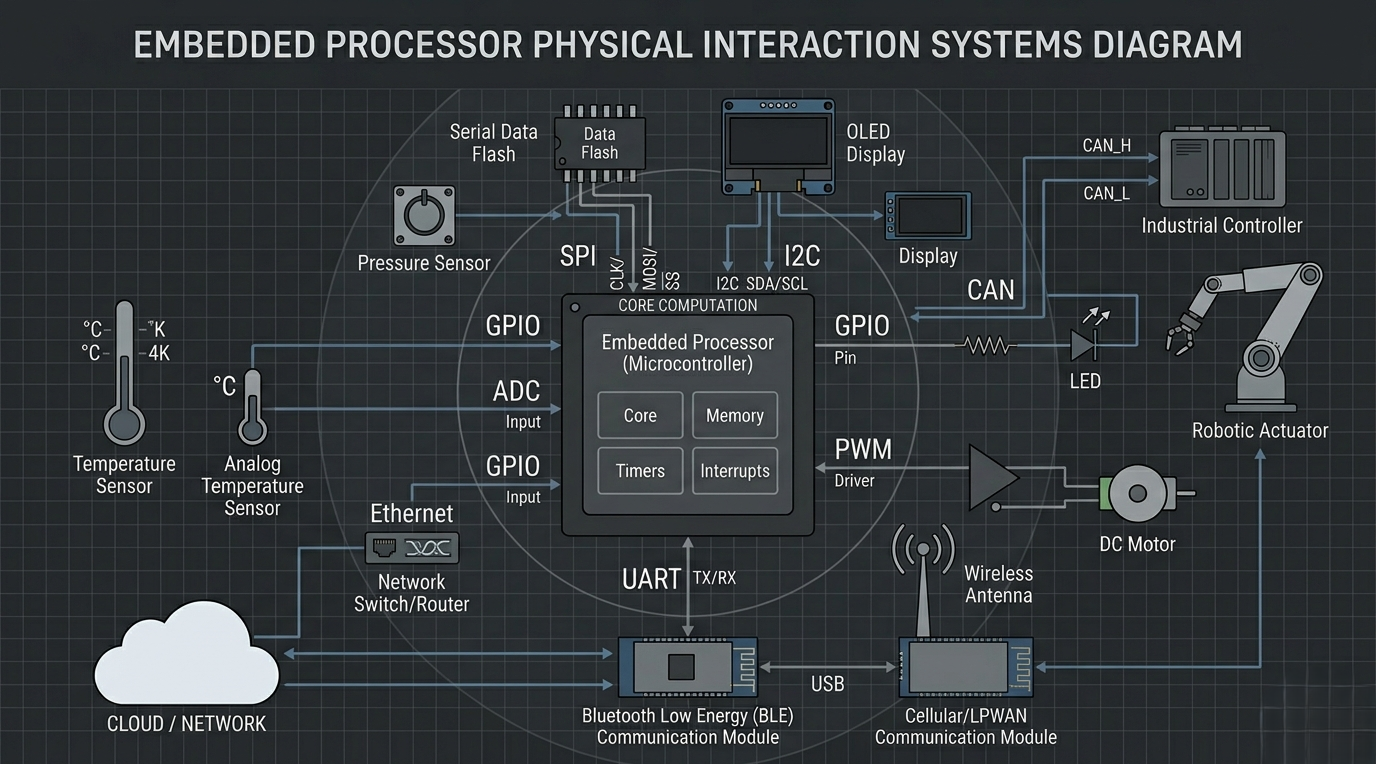
A processor can compute internally forever. But without interfaces, it cannot observe, respond, or interact with the physical world around it.
By the time a processor exists, an enormous amount of engineering has already happened.
Silicon has been purified. Transistors have been fabricated. Logic has been organized into computation.
But even after all of that, a CPU still has a limitation.
It only processes internal electrical states.
The physical world is continuous.
Temperature changes gradually. Sound behaves as waves. Light intensity varies continuously.
Processors, however, operate through discrete electrical states — transitions interpreted as binary information.
This creates a boundary between computation and reality.

Interfaces allow computation to observe and influence the physical world.
One of the simplest forms of interaction is General Purpose Input/Output — GPIO.
At first glance, GPIO feels like software changing a value.
But underneath, this changes voltage on a physical pin.
Eventually, something outside the processor responds: en LED turns on, a relay switches, a motor moves.
As systems became more complex, simple pins were no longer sufficient.
Some devices needed faster communication. Others needed multiple devices sharing connections. Some needed longer-distance reliability.
This is why multiple communication models emerged.
UART prioritized simplicity. SPI prioritized speed. I2C prioritized scalable device communication.
At a distance, embedded systems appear to be about processors and software.
But much of embedded engineering is actually about controlled interaction with the outside world.
Sensors continuously feed information inward. Actuators push decisions outward. Communication buses coordinate systems together.
The processor becomes the center of an ongoing exchange between computation and reality.
Modern computation often feels abstract because most systems hide the physical world beneath layers of software.
Embedded systems rarely allow that separation completely.
PrajnaEdge is an interactive engineering platform where complex concepts become experiences—through visual explorations, simulations, and practical understanding.
Engineering is often taught as a collection of isolated concepts.
A processor here.
A protocol there.
An operating system somewhere else.
But real systems are built by connecting these layers.
PrajnaEdge exists to make those connections visible.
Each exploration starts with a question, builds an intuition, and gradually reveals the system underneath through visualizations, simulations, practical scenarios, and connections between concepts.
PrajnaEdge is designed around exploration rather than passive reading.
Concepts are introduced progressively, visualized when they benefit from seeing them, and brought to life through interactive EdgeCases and simulations where appropriate.
The goal is not simply to explain what a system does, but to help the learner understand why it works the way it does.
I am the engineer behind the design, development, and content of PrajnaEdge. I build low-level systems where code directly controls hardware, bridging the gap between register-level silicon behavior and intelligent edge decision loops.
I am an Embedded Firmware Engineer focused on developing software for resource-constrained systems. My experience spans bare-metal firmware, device drivers, microcontroller peripherals, and communication protocols, working across the boundary between hardware and software.
My work has involved microcontroller-based systems, real-time behaviour, hardware interfaces, and communication technologies such as CAN, CAN FD, UART, SPI, and I²C. I am particularly interested in understanding systems from the lowest level upward—from registers and peripherals to intelligent edge systems.
Engineering is not just about writing code; it is about managing constraints, timings, and physical hardware characteristics. True mastery of complex systems comes from understanding the interactions across different layers of the stack.
This conviction is why I built PrajnaEdge—to bridge the gap between conceptual theory and direct, register-level physical reality.
Software that runs directly on hardware without an operating system.
"Every embedded application begins long before main()."
An Operating System manages hardware and software resources so complex applications can work efficiently.
"When one loop is no longer enough to carry the burden."
PrajnaEdge is an independent education platform built to make knowledge freely accessible.
If you find PrajnaEdge useful, you can support its continued development.
Your support helps fund the time, tools, infrastructure, and experimentation that go into building and maintaining PrajnaEdge.
Product Terms & Licensing
PrajnaEdge is an interactive learning platform designed for systems engineers, developers, and technology enthusiasts. The educational materials, simulation blocks, and visual code tracers are provided for instruction and concept validation. We make no warranty regarding their completeness or applicability to real-world industrial systems.
The software, interactive widgets, diagrams, illustrations, custom SVG architectures, and textual documentation on this site are copyright © 2026 PrajnaEdge. All rights reserved. Reproduction, modifications, or scraping of this content without prior written permission is strictly prohibited.
PrajnaEdge is committed to learning privacy. We do not sell user data. Analytical event tracking is used solely to study click telemetry and help improve visual guides.